Thursday, May 2, 2013

Conference....Science in the Classroom! It's Natural

So I said earlier that I have been busy... that is an understatement!  Not only is it baseball and soccer season at my house but I have recently become more active in science leadership opportunities in my region.  My good friend, Sherrie, and I took on a new responsibility of being our Regional Directors for the Virginia Association of Science Teachers.  We have enjoyed going to meetings and really seeing what is going on at the front lines of science leadership. One of our new responsibilities was to offer a mini-conference for teachers in our region.

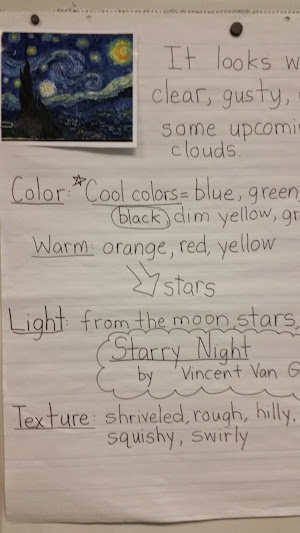
We were able to secure many high quality teachers (from our division) for an amazing day of science! I really wanted to focus on K-2 because they are often the "lost" ones in science educational development.  We had several really good sessions for them including "thinking like a six year old" - cognitive connections and more! We also had one on Art and Science connections, Science Notebooks and taking science outdoors.  Our master gardener spoke about local resources available to us as well.

Photo: Here we are with Einstein fellow Lynn Reed!My upper grade sessions were also high quality including an amazing session on Oceans for fifth grade teachers, nature journals, the flipped classroom, STEM in the classroom and polar habitats.

Our keynote speaker, Lynn Reed, was an Einstein Fellow from Richmond who is working with the NSF on polar science for two years.  She was able to go to Greenland and Antarctica to participate in scientific studies on polar changes, weather and more.

She recommended a few really good websites:   www.penguinscience.com is great! It is a place where students can learn about the Adele penguin, ask questions to the scientists studying them in Antarctica and even get a postcard stamped from the south pole! Click on the penguin to learn more!

Another site that I have visited before is Beyond Polar Bears and Penguins. This site is just what is says...something more than just cutesy arts and craft projects!This website is thematic in nature (cross curricular) that includes literacy, math and science.  It offers professional development articles, and kid friendly research from "in the field".

Here's to hoping that I can be more active on the blog scene again....of course, now it's time for State Testing! (Boo hiss)


Wednesday, April 10, 2013

Earth Day is coming...


I have been really busy lately and admit I am behind on my postings.  Having said this, there are many exciting things going on at my school for next year - including a new STEM lab, a restructuring of our instructional day, and more!

So I thought that I would repost my favorite lesson for Earth Day from last year.  This is a GREAT activity that really makes its point!


I love the Lorax!  I have ever since I was old enough to read it...I remember watching it on TV long before there was such thing as Earth Day (or at least one recognized in schools!) I loved the idea of helping the planet then, and I love the idea of helping the planet now.  So when I saw an article using this book highlighted in NSTA's magazine Science and Children this month,(April/May 2012)  I knew I had to duplicated it in my classroom.  The article, Truffula Tree Troubles, was written by Robert Snyder and addresses the issue of tree harvesting. My class had just finished reading Owl in My Shower which is a great book that also addresses the issue of logging rights vs. ecological issues.   We were already familiar with the idea that there are two sides to every story.

Anyway, you can find the article for purchase at the NSTA store and I highly recommend you do that to get the full lesson plan.  The article gives objectives, materials and a detailed lesson plan that follows the 5 E's nicely (Engage, Explore, Explain, Elaborate and Evaluate),  I will give you a quick run down on the "gist" of the activity...

You will replicate the idea of cutting down trees like the Oncler did using 5 different types of noodles.   I started off by reading from the book until they get to the section where the oncler starts chopping down all the trees. At this point I have the children get into small groups. (My students already work daily in cooperative science groups with rotating jobs which really helped with this activity.) Each group is assigned a card with a noodle attached. That is the "tree" their group will harvest.  I pointed out to them that just like a real forest doesn't have an equal amount of trees, either will they.  Some groups will have more than others.

You will put all the noodles on a drop cloth (I used a plastic table cloth) for easy harvesting (and clean up).  Then each group will send one member to the "forest" to harvest their trees for 45 seconds.  After that time, they will return to their group and record the number of trees harvested.  They will do this 8 times.

The students (like the once-ler) were very excited at the beginning to harvest many trees at once.  However, after several trials...they noticed that they were getting fewer and fewer trees...and suddenly ... the trees were gone!

What a great opportunity to discuss with them the idea of renewable and non-renewable resources.  We discussed that some natural resources are non-renewable - meaning that once they are used up they are gone for good.  That's what happened to the Once-ler and the Truffula trees.  However, we learned in Owl in the Shower that forests can be renewable resources if loggers don't just clear cut and move on, but instead replant after each cut.  That is what we are trying to do here in Virginia with our logging industry.

In the NSTA article, Robert Snyder had included some fantastic follow up questions.  In keeping with my science notebook process, I re-wrote the form to include his idea of a data chart, a line plot, a conclusion (my idea) and a reflection (his idea).

You will notice that I purposefully left the line plot unmarked - that is so you can hand write the trials at the bottom (# 1-8) and the amount of noodles on the side.  I had written only up to 40 noodles per handful (counting by 5's) and I have to say the kids far exceeded that amount.  When I do it next year, I will write the numbers by 10's up to 80 instead.  You can down load it for free at my TPT store.

Thursday, March 21, 2013

American Idol Math

 Yes, I did just say math....I usually only blog about science, but today is an exception.  I've got to share with you my favorite way to teach probability, fractions and decimal connections.  My good friend, Sherrie Roland, came up with this idea many years ago and shared it with me. I have done it for the past three years and each year I believe it is one of the best ways my kids make sense of probability and fractions....through the events that happen on American Idol!

I must admit, this year has had me on my toes!  Usually we have some time to explore with 18 contestants and watch them dwindle down to the top 12.  But this year we went from the top 20 to the top 10 in one week!

Here's how we start....I created a bulletin board that shows the top 20 contestants with their official photo shoot pictures. 


 After they were eliminated, and we went from 20 to 10 we noticed that we had lost 10/20 contestants which is the same as 1/2 which is the same as 50%.  We also noticed that of the 10 contestants who were voted off, 5/10 were girls and 5/10 were boys.  So 10/20 = 5/10 = 1/2 = 50%.

Some of the ways that we keep track of the data each week is by comparing the fractions of girls vs. boys, subtracting fractions with like denominators and searching for equivalent fractions. 

We also practice probability by plotting the likelihood of a boy or girl winning each week on the likelihood line.  The B and G are on index cards that we can manipulate and move along the line - describing the data using percentages, fractions and vocabulary.


Next up, I create a journal for them. It's a simple white covered journal with about 7 pieces of notebook paper in it.  They get to decorate the cover with the title American Idol Math.


Inside I give them a copy of the top ten contestants with their names on it. For the next 10 weeks, we will count down the contestants that get voted off.  As we do we write in our journals to keep track of what is going on.  Last year I predicted Phillip Phillips early on and I have it in print to prove it!


Here is the general format:

Last night ______ got voted off.

9/10 - 1/10 = 8/10

5/10 Girls and 3/10 Boys.  There is a greater likelihood of a girl winning this year than a boy. 

(Draw a likelihood line on the notebook - plot the fractions on the line)

Sometimes we write our favorite part from the night before depending on the night or the time.

Hope you can use this!


Saturday, February 23, 2013

Drawing Conclusions

I know I am not the only teacher out there who when asking how to draw a conclusion, gets the response "you need to draw a picture."  In my case, it makes perfect sense! I teach the kids all year to draw to show your understanding of a concept.  However, when they see that as a test question - drawing a picture is not an option, right?

So to address this idea, my teammates and I decided to start with the fact that draw is a multiple meaning word.  I started with a graphic organizer with the word draw in the top box.

Then, we brainstormed all the meanings of draw - to draw a picture, to draw a card, to draw blood, to draw the blinds, etc... One of my kids said "underwear...you know drawers!"  Ha ha.. don't worry I cleared it up!

We talked about the fact that draw means to pull out in many situations.  The same is true when you draw a conclusion. You are pulling out information from an experiment that you have finished or a text you have read.

Example from the classroom...


We have been working on conductors and insulators in my science class.  We started with a question:  What materials conduct electricity or insulate electricity?

I predefined what the science terms mean with a science word chart.


Science words
What they mean
Conductor
 
insulator
Allows electricity to flow  through it
 
No electricity flows through it


Then they were given a baggie of materials to test in the circuit. The materials would be placed one at a time where the switch connects to complete the circuit.  These were the same objects we tested as being attracted to a magnet by the way and so many kids were convinced the same materials would work as conductors.  Of course, that was not the case.

They explored and tested and recorded their data on a T chart. They were surprised that all metals worked in the circuit - not just iron and steel.

When we finished it was time to "draw a conclusion".  To help them with this idea we looked back at our question and our data.  I wrote a sentence frame for students who felt like they needed extra support (ESL, SPEC ED, ADHD, etc...)  We also talked about the fact that wood does not complete a circuit, but also would not be a good insulator due to fire risks.  They got that pretty easily!

I conclude that ________________ materials conduct electricity.  Insulators can be made of __________________________________________. 


Hope this example helps you out! 

Comment:

Tuesday, February 12, 2013

Thomas Edison

We are working on the FOSS unit Magnetism and Electricity - another one of my favorite units! So far we have explored what is attracted to magnets using plastic bags full of materials.  Many of the materials are duplicates, only one is made of iron or steel and the other of another non-magnetic substance. 

We have begun exploring how to create a circuit using D-cells and light bulbs.  Students are learning new vocabulary such as energy source and energy receiver, circuits and filament. As part of this lesson we are introduced to Thomas Edison. 

Lewis Latimer
Did you know that Thomas Edison did NOT invent the light bulb? He was an engineer - he found an existing problem and using through trial and error worked to find a better way. It was not until he met Lewis Latimer, an African American inventor that the modern  light bulb was improved to last more than a few days.  Thomas Latimer had created a filament that would not burn out quickly. Together they figured out a way to vacuum out the air, so that there would be no oxygen in the glass bulb for the filament to catch on fire.


Anyway....I have created a worksheet to use as a follow up to introducing Thomas Edison.  I tried to include a passage about his childhood love of asking questions as a spark or connection for our kids.  Then we ask them to imagine what they would invent if they could.  

Grab it free here!


Comment:

Sunday, February 3, 2013

Super Bowl Sale

Around my house, football is on!  My boys love to watch football from August until February...routing for their favorite players all year long.  This year we are so excited to see the Ravens in the Super Bowl!  We are actively cheering on home town player - Torrey Smith - from Stafford, Virginia where we live. 

In honor of the super bowl, I am offering a sale of 15% on my products that costs $5 or more. I hope you will visit my store and pick up something you have been looking for!


Comment:

Tuesday, January 29, 2013

Compare & Contrast..an integrated approach

Integration...a big idea.  In the past, I have thought of integration as a form of connecting topics or themes across content areas.  Think about teaching Ecosystems and reading about animals, using animals to measure or do math, as well as learning about it in science. That's really more like Cross Curricular, isn't it?

But Integration is when we teach thinking ideas or structures in all areas of your curriculum.  For example, we are learning about compare and contrast this month.  How are we doing this?

First we introduced the concept of Compare and Contrast as a whole group using photos of colonial Virginia houses based on architecture of German and English settlers.  By observing the pictures, students were able to notice what was similar and different.

Then we introduced the signal words: Compare (how they are alike) and Contrast (how they are different).  Signal words for compare: also, both, too, similar, the same as,more, like, as well as, alike. Signal words for contrast: but, however, too, different, from, compared to, in contrast, unlike, less.

We purposefully integrated this skill of compare and contrast into everything we did - Social studies, math, reading and science.


In Math, we are teaching polygons.  As part of this unit, we were able to sort and classify polygons based on common attributes.  We were able to manipulate the polygon shapes with a partner, play guess my rule, and sort shapes on the Smart Board.  When we compared the shapes we used the signal words to talk about similarities and differences. 
 
In reading, we compared and contrasted character traits in our Trickster Tales from around the world.  How was Brer Rabbit like Anansi? How were they different? We read non-fiction selections about seals and sea lions and compared how they behave in the wild. We circled signal words that we could find in the passage.  Compare words were pink (as was the compare statement area). Contrast words were in purple (and so wat the contrast statement area.)
 
In Science...we compared and contrast force and motion concepts with exit cards:  How are pushes and pulls alike? Different? Rollercoasters vs. Ramps & Cars, Rube Goldberg vs. Roller coasters, Kinetic vs. Potential....
I am offering this resource for FREE. Click here to get it - I put two cards on a page for a total of 8 exit cards. Enjoy it!